
Farm equipment is the one application where the hydraulic cylinder is more likely to fail from idleness than from work. That single fact reshapes the specification.
The duty cycle is short and violent, then absent
A grain trailer tips perhaps 40 times a harvest and then sits for ten months. A loader cylinder on a livestock farm runs 200 cycles a day all year. Both are agricultural, and they need different cylinders, but the market treats them as one.
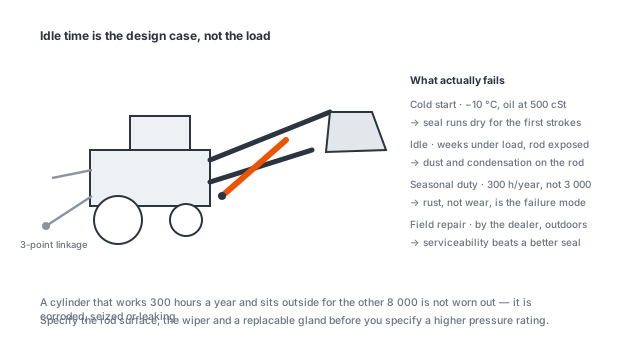
For the trailer, the enemy is corrosion. The rod is exposed at whatever position the trailer was parked in, rain collects on it, dust settles on the film and the next start drags an abrasive paste through the wiper. The cylinder has done almost no work and the seal is already worn.
For the loader, the enemy is contamination and side load. Bucket work puts a bending moment on the rod that no catalog rating covers, and the bucket pivot pins wear until the geometry pushes the cylinder sideways.
Grain trailer: capacity follows volume, not weight
A tipping trailer’s cylinder is chosen from the body volume and the hinge geometry, not from the payload alone. A 24 m³ grain trailer at 750 kg/m³ carries 18 t, and tipping it needs enough force at the worst point in the lift, which is at the start when the load’s centre of gravity is furthest from the hinge.
The underbody telescopic range covers 5 to 25 t of tipping capacity with 3 to 6 stages, 806 to 1,947 mm of power stroke and 8.5 to 14 L of working volume in the E130 series. A 24 m³ grain trailer usually lands in the E130 series at the upper end of the capacity range, because the first 20 degrees of tip require the most force and the cylinder has the least mechanical advantage there.
Two details matter more here than on a construction tipper. Port options (G1/2, G3/8, M22, M18, NPT1/2) should match what the farm’s tractor already uses, since adapters are where leaks start. And the rod should be protected at rest: a cylinder parked with 300 mm of rod exposed for ten months will pit, so specify a boot.
Loader and implement cylinders
Front loader work is a different specification. The cylinder sees side load from the bucket, high cycle counts, and a pressure spike every time the bucket hits the ground. Bores land in the 63 to 90 mm range with rods at 0.6 to 0.7 times bore, and the mounting should be a spherical bearing at the rod end rather than a plain clevis.
Where implements need a self-contained power source, the DC hydraulic power unit covers 12 V or 24 V, 0.75 to 8 cc/rev, 3 to 25 L/min, 3 to 16 L reservoirs and 50 to 250 bar, with cable or wireless control. A wireless remote on a livestock feeding wagon or a bale wrapper removes a cable that would otherwise be the first thing to fail.
Cold start is a design case
A farm starts work at dawn in February. Mineral oil at -10 °C is roughly ten times more viscous than at 40 °C, and a pump pulling that oil through a suction line sized for warm oil cavitates for the first few seconds. The damage is done to the pump, not the cylinder, but the symptom appears as a slow, juddering first lift.
Three fixes, in order of cost: idle the engine for three to five minutes before the first lift, run VG 32 instead of VG 46 in winter, or fit a suction strainer with a bypass so the pump is not starved. The first costs nothing.
What to send
Body volume and hinge geometry for a trailer; bucket width and loader linkage for a loader; the tractor’s spool type and port size; and the coldest start temperature. Those four answers cover most of what changes between one farm and the next.