
Container handling without a crane comes down to two mechanisms, and the choice between them is a question of how often the box moves rather than how heavy it is.
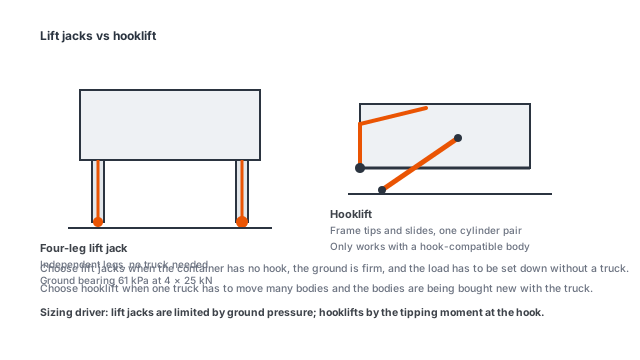
Lift jack: four legs at the corner castings
The hydraulic container lift jack is a set of four independent legs, each rated 8 t, giving 32 t for the set. Each leg carries a 2 kW motor on the 24 V version or 2.2 kW on the 380 V version, and lifts at 21 mm/s to a maximum height of 1,700 mm. Leg dimensions are identical on both versions at 1,140 × 1,120 × 2,575 mm, with the 24 V leg weighing 800 kg and the 380 V leg 760 kg.
The 1,700 mm lift height is the number that matters, because it is set by what has to fit underneath. A standard container chassis deck sits at about 1,300 to 1,500 mm, and the leg has to clear that with margin for suspension compression when the trailer backs in. 1,700 mm gives roughly 200 mm of clearance on a loaded trailer, which is tight but workable.
At 21 mm/s the full stroke takes about 81 seconds. That is slow by crane standards and fast enough that the crew is not waiting; the real time cost is positioning four legs under four corner castings, which is why the job is normally planned around one lift per box rather than repeated lifts.
What the four-leg arrangement demands
Independence is the strength and the weakness of a jack set. Four separate legs can handle a container on uneven ground and can lift one end at a time when a trailer needs to be swapped. They cannot, however, level themselves.
Each 8 t leg transfers about 78 kN to the ground through a 1,140 × 1,120 mm footprint, which works out to roughly 61 kPa. That is comparable to a loaded truck tyre and enough to punch through hot asphalt. The surface requirement is compacted gravel, concrete or a purpose-built pad, and the pad has to be flat because a 10 mm step under one leg becomes a visible tilt on a 12 m box.
The second constraint is the corner castings. The legs lift at the standard ISO corner fittings, so the box has to be a standard ISO container. A swap body or a non-ISO pallet box will not have the fittings in the right place, and no amount of hydraulic capacity fixes that.
Hooklift: the same job from the chassis
A hooklift carries its own lifting gear. A jib arm picks up a hook on the container front, the main cylinder pulls the box up a tilted subframe and the box lands on the truck bed. The HCIC hooklift range covers 5.5, 6 and 18 t of lift capacity in 5 models, with self weight from 1,000 to 2,600 kg, jib heights of 1,500 to 1,600 mm, overall lengths of 3,800 to 5,880 mm and a secondary beam width of 750 or 850 mm.
The 18 t model is the one that changes what a small fleet can do, because it can handle a loaded 20 ft box without a second vehicle. The trade is the 2,600 kg of self weight sitting permanently on the chassis, which comes straight off the payload.
| Lift jack set | Hooklift | |
|---|---|---|
| Capacity | 8 t per leg, 32 t per set | 5.5 / 6 / 18 t lift |
| Moving part | four independent legs | jib and subframe on the truck |
| Needs a dedicated truck | no, works with any trailer | yes |
| Setup time per box | 8–12 minutes | 2–4 minutes |
| Best fit | yards, depots, low volume | fleets moving boxes daily |
Choosing between them
Count how many times a box moves per week and who owns the trailer. If boxes move occasionally and the trailers belong to customers, the jack set is the only option that does not require buying a vehicle. If the same truck moves five boxes a day, the hooklift pays for itself in labour within a season.
A third case sits between the two: a yard that lifts boxes onto trailers but never moves them itself. That is lift jack territory, and the specification question becomes whether 24 V or 380 V suits the site. The 24 V version runs from a battery bank and can be moved by a small utility vehicle; the 380 V version needs a mains connection but is 40 kg lighter per leg and holds lift speed under load better.
Sizing checklist
Confirm three things before ordering either system: the gross weight of the heaviest box including cargo, the deck height of the trailers that will receive it, and the ground surface at the lift point. Those three numbers decide whether a jack set is adequate, which of the two voltages suits, and whether a hooklift is the better purchase.
The model tables on the two product pages give the full dimensional data for both families.