
The choice is decided by where the cylinder can physically live, not by tonnage. A dump truck has two usable envelopes: the tunnel between the chassis rails, and the vertical space between the cab rear and the body front board. Everything else follows from that constraint.
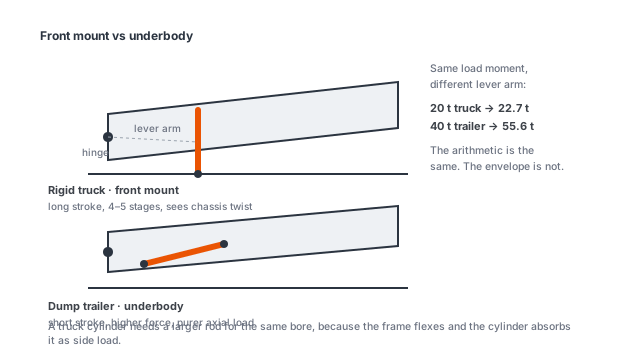
How the two mounting families divide the work
An underbody cylinder lies almost flat, anchored to a chassis crossmember and pushing the body through a linkage. Because it is horizontal, the whole cylinder length sits inside the frame envelope, which keeps the centre of gravity low and leaves the body floor flat. The trade is stroke: the cylinder only pushes through a shallow arc, so it needs a linkage ratio and a long power stroke.
A front-end cylinder stands nearly vertical behind the cab. It pushes the body directly, so there is no linkage to absorb load and the geometry is simple. The cost is height: the cylinder occupies the space between cab and body, and the closed length decides how far forward the body must sit.
| Underbody | Front-end | |
|---|---|---|
| Typical capacity | 5–25 t | 28.3–64 t |
| Stages | 3 to 6 | 3 to 6 |
| Power stroke | 806–1,947 mm | 1,195–1,945 mm |
| Pressure | 180–220 bar | 16–20 MPa |
| Best fit | trailers, light tippers, low-CG bodies | rigid tippers, quarry and construction |
Both families are telescopic, which matters more than it sounds. A single-stage cylinder long enough to reach 50 degrees would need a closed length close to its stroke, and no truck frame has that much room. Splitting the stroke across four to six stages keeps the closed length at roughly a third of the extended length.
Pressure is the variable that decides your pump
The same tipping capacity can be reached with a large bore at low pressure or a small bore at high pressure, and the second option is cheaper until it is not. Take the E130 underbody series: a 130 mm effective diameter stage at 180 bar produces about 239 kN, or 24.4 t, at the first stage. Raise the pressure to 220 bar and the same cylinder gives about 292 kN. Nothing about the cylinder changed, only what the pump is set to.
That is why cylinders are quoted with a pressure band rather than a single number. If your truck already runs a 180 bar system, specifying a 220 bar cylinder buys nothing unless you also change the pump setting. Conversely, ordering a cylinder rated at 180 bar for a 220 bar system is how barrels crack at the weld neck.
Force check: F = p × A. For a 130 mm bore at 180 bar, F = 18,000,000 × π/4 × 0.130² ≈ 239 kN.
What actually fails first
In order of frequency on tipping duty: rod seal leakage from side loading, barrel distortion at the base weld, and stage scoring from contaminated oil. All three trace back to the same cause, which is misalignment between the cylinder axis and the load line.
An underbody installation hides misalignment well because the linkage tolerates a few degrees of error. A front-end installation does not. If the body hinges and the cylinder base bracket are not in the same plane, the rod takes a bending moment on every tip and the seal fails within a few thousand cycles. Specify spherical bearings at both ends, or at minimum a self-aligning base clevis, and check the bracket alignment after the body is mounted rather than before.
The second failure mode is pressure spike. When a loaded body is lowered fast and the control valve closes, the cylinder sees a pressure surge well above system pressure. A counterbalance valve set 15 to 20 percent above the rated pressure is cheaper than replacing a barrel.
Matching cylinder to body volume
A cylinder that is too small will not tip a full load; one that is too large adds weight and cost. The practical check is working volume against body volume. The E130 series runs 8.5 to 14 litres of working volume across the range, and a 20 m³ body at 180 bar needs the upper half of that. If you are choosing between two models with the same bore and different stroke, take the longer stroke and set the linkage to stop earlier.
Send the body drawing, the hinge position and the pump pressure you already run, and the cylinder falls out of the table rather than being guessed.
Choosing within the range
Start with the mounting envelope, then check capacity, then check working volume. The product pages below carry the full model tables with power stroke, mass, working volume, tipping capacity and dimension letters, so you can match against your own body drawing without a phone call.