
Three constructions cover almost every industrial and mobile cylinder: tie rod, welded body and mill type. The choice is usually made by habit, and the correct answer is set by pressure, bore and what happens the first time the cylinder needs resealing.
This is a selection judgement, not a product page. Our own catalogue has no welded-body cylinder line, and this article does not pretend otherwise — it explains when welded construction is the right specification and what it costs you afterwards.
The three constructions
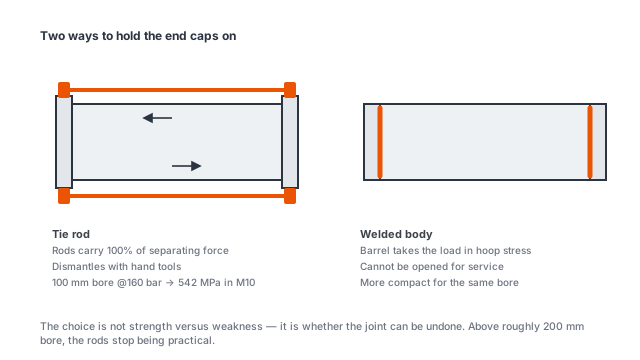
Tie rod. The barrel is a tube; end caps are retained by two or four threaded rods running the length of the cylinder. The cylinder can be dismantled, re-sealed and reassembled with hand tools. This is the ISO 6020/2 family, rated at 160 bar for the compact series, and it is the most common industrial cylinder in the world.
Welded body. The end caps, or the cap and the gland housing, are welded to the barrel. There are no tie rods, so the cylinder is more compact for the same bore and pressure and can take more side load. It cannot be dismantled for service without cutting it open. This is the construction used on most mobile and construction equipment.
Mill type. A heavy construction with a bolted or threaded gland, sometimes a bolted head, designed for large bores and high pressures. Serviceable, but heavy and expensive. ISO 6022 covers the 250 bar range where this construction becomes necessary.
Where tie rods run out of margin
The tie rods carry the full separating force, and that force grows with the square of the bore. At some point the rods become the constraint rather than the barrel.
Take a 100 mm bore at 160 bar. Separating force is:
F = 16,000,000 × π/4 × 0.100² = 125,700 N
With four M10 tie rods, each with a tensile stress area of 58 mm², the stress in each rod is 125,700 / (4 × 58 × 10⁻⁶) = 542 MPa. That is within the yield of an 8.8 bolt, but it leaves very little margin once preload, bending from uneven tightening and fatigue cycling are counted — and fatigue is how tie rods actually fail.
Move to 200 mm bore at the same pressure and the force quadruples to 503 kN. Four M16 rods (157 mm² each) give 800 MPa, which is past yield. The options are more rods, thicker rods, or a construction that does not use rods at all. That boundary is where welded and mill-type construction take over, and it arrives sooner than most people expect.
Welded construction has no such arithmetic limit. The barrel-to-cap joint is a full-penetration weld around the whole circumference, and its capacity is set by weld quality and wall thickness rather than by bolt area. That is why large-bore, high-pressure cylinders are welded or mill type and small industrial cylinders are tie rod.
What welded construction buys
- Compactness. No tie rods means a smaller envelope for the same bore and stroke, which matters where the cylinder has to fit inside a machine structure.
- Side load tolerance. A welded body with a threaded or bolted gland takes side load better than a tie rod cylinder, where side load shows up as uneven rod loading and tie rod bending.
- Higher pressure for the same size. Without the rod area constraint, pressure rating is set by wall thickness.
- Better shock resistance. Welded joints do not work loose. Tie rod nuts do, which is why tie rod cylinders on high-shock equipment need periodic re-torque checks.
What it costs
- Field serviceability. A tie rod cylinder is resealed in an hour with spanners. A welded cylinder needs a press, a weld and a re-machine. On a machine that is far from a workshop, that difference decides it, and it is the strongest argument for tie rod construction on remote equipment.
- Weld quality dependence. Everything rides on the weld. A tie rod cylinder with a poor weld has no weld in the load path; a welded cylinder with a poor weld has nothing else. This is why welded cylinders are the place where a qualified welding procedure matters most.
- No re-machining allowance. If the bore scores, the cylinder is scrap rather than a re-hone job.
When to specify welded
Three conditions, and they tend to arrive together:
- Bore above roughly 160 to 200 mm at pressures above 160 bar. Tie rod margin is gone.
- The envelope is tight. No room for tie rods or their nuts.
- The cylinder is a fitted, replace-as-a-unit component. Mobile equipment cylinders are replaced, not repaired, in most fleets.
When to stay with tie rod
- Remote sites with no workshop. Resealing on site is worth more than compactness.
- Standard industrial duty at 160 bar and below, bores to about 200 mm. ISO 6020/2 interchangeability means a replacement is a catalogue item, and the dimensional standard is what makes that true.
- Applications that get resealed on a schedule. If the maintenance plan already includes periodic seal changes, do not specify a construction that turns a one-hour job into a workshop job.
What to check when you do specify welded
The whole case for welded construction rests on weld quality, so ask for the same four things you would ask for on a pressure vessel:
- A welding procedure specification, qualified by a procedure qualification record, to a recognised standard.
- Weld examination. Dye penetrant or magnetic particle on the base and cap welds as a minimum, ultrasonic on larger sections.
- Stress relief where wall thickness and material require it. Skipping it leaves residual stress at the weld, and residual stress plus pressure cycling is the classic recipe for a cracked base.
- Proof testing at 1.5 × working pressure with a per-unit record, not a batch certificate.
Those four are the difference between a welded cylinder that outlasts the machine and one that cracks at the cap after a season. A supplier who cannot show all four is selling a welded cylinder on the strength of its paint.
Cushions and the end of stroke
The end of stroke is where welded cylinders most often fail, and the failure usually arrives together with a cushion problem. A cushion is a restrictor that slows the piston over the last portion of travel by forcing the exhausting oil through a small orifice. Without one, the piston arrives at the end cap at full speed, and the load’s kinetic energy is absorbed by the cap, the weld and the rod.
On a welded cylinder, that energy goes into a joint that cannot be dismantled or inspected. On a tie rod cylinder it goes into rods that can be replaced. This is one of the practical reasons welded construction should always be paired with a working cushion on long-stroke, high-inertia applications, and why a cushion adjustment that has been screwed in too far is a more common cause of cracked caps than an undersized cylinder.
Check three things on any cushioned cylinder: that the cushion actually engages before end of stroke, that the adjustment is accessible, and that it has not been closed to the point where the cylinder stalls short of full travel.
The honest summary
Welded is the right answer when pressure, bore or envelope force it, and when the cylinder will be replaced rather than repaired. Tie rod is the right answer when the machine is remote, the duty is standard and the dimensional interchangeability of ISO 6020/2 is worth more than compactness. Mill type is the answer above 250 bar or with very large bores.
If you are specifying for a machine where you have not made this decision explicitly, it is worth ten minutes to do so — because the construction, not the bore, is what determines whether the cylinder can be serviced where it works.