
The AC-or-DC question looks like a power supply question and is actually a duty cycle question. Almost every DC power unit that fails early failed because it was specified as a smaller AC unit rather than as a different machine.
Start from oil volume, not from motor power
Every cylinder movement consumes a fixed volume of oil: bore area × stroke. That volume, divided by the pump flow, gives the actuation time. Everything else follows.
For a single-acting cylinder with a 100 mm bore and a 500 mm stroke:
V = π/4 × 0.100² × 0.500 = 3.93 L
At 6 L/min of pump flow, that is 39 seconds. At 12 L/min, 20 seconds. The pump size is chosen from the actuation time the operator will accept, and it is the same arithmetic whether the motor is AC or DC.
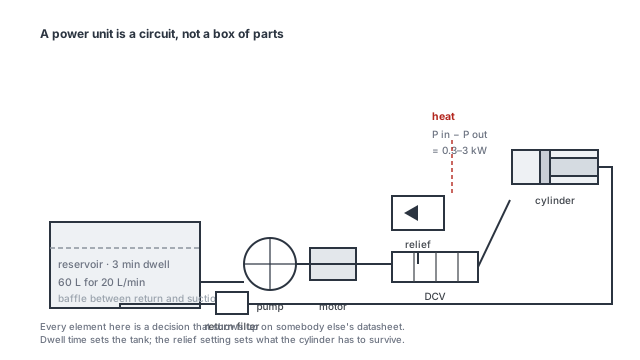
What differs is what happens next. An AC motor can run continuously and shed its heat into a large oil volume and a fan. A DC motor on a battery has a duty rating measured in minutes, draws current that has to be carried by cable, and puts its heat into a reservoir that is typically 3 to 16 litres.
The current calculation that decides it
Hydraulic power is pressure times flow:
P = p × Q
At 180 bar and 6 L/min, that is 18,000,000 Pa × 0.0001 m³/s = 1,800 W of hydraulic power. Dividing by a realistic overall efficiency of about 0.85 gives roughly 2.1 kW of electrical demand.
Now divide by voltage:
| Supply | Current for the same 1.8 kW hydraulic output |
|---|---|
| 24 V DC | ≈ 88 A |
| 12 V DC | ≈ 175 A |
| 400 V AC three-phase | ≈ 4 A |
That table is the whole argument. The same hydraulic job costs 175 A on a 12 V system and 4 A on three-phase. Cable cross-section, connector size, alternator capacity and fuse rating all scale with current, which means a 12 V unit doing real work is not a cheaper AC unit — it is an expensive one with a short duty rating.
Duty rating is the number most often missed
A DC motor on a power unit is rated for a duty class, not for continuous running. A typical intermittent rating is a few minutes of operation followed by a rest period long enough to shed the heat. A tail lift doing 20 cycles an hour exceeds it. A compactor running continuously exceeds it by an order of magnitude.
The symptom is not usually a burnt motor. It is a slow lift on the tenth cycle of the morning, which gets diagnosed as a weak pump or a failing battery. The motor is fine; it is hot.
The reservoir is the heat sink. A rule of thumb worth using: reservoir capacity should be at least three times the pump’s per-minute flow for continuous duty, and at least the swept volume of the cylinder for intermittent duty. The DC unit range covers 3 to 16 L against 3 to 25 L/min of flow, which means the top of the flow range needs either the 16 L reservoir or an oil cooler.
When DC is the correct answer
DC wins on four conditions, and all four have to be true for the answer to be comfortable:
- No mains supply at the point of use. A trailer, a mobile conveyor, a livestock feeder, an implement behind a tractor. This is the main reason and it is decisive.
- The machine’s own electrical system is already there. A truck with a 24 V system and a healthy alternator is a reasonable power source for a liftgate.
- The duty is genuinely intermittent. One or two actuations per stop, or a few per hour, not continuous running.
- The function is single-acting with gravity return. Pump one way, gravity the other. This halves the oil volume the pump has to deliver and is why tail lifts and tipping trailers are the natural DC applications.
When AC is the correct answer
Everything else. Specifically: continuous duty, multiple simultaneous functions, flows above about 25 L/min, pressures consistently at the top of the range, and any installation where a three-phase supply already exists within a reasonable cable run.
An AC unit also tolerates being oversized. A 4 kW AC motor running at 2 kW of load is comfortable. A DC motor run continuously at its intermittent rating is not, because the heat has nowhere to go and the battery is finite.
Decision table
| Condition | Answer |
|---|---|
| Mains or generator available at the machine | AC |
| Flow above 25 L/min | AC |
| Continuous or near-continuous duty | AC |
| Multiple functions moving at once | AC |
| Mobile, no mains, intermittent | DC |
| Single-acting with gravity return | DC, comfortably |
| Double-acting, frequent cycling, mobile | DC with cooler and oversized reservoir |
The last row is the difficult case and it is where most field problems live. A mobile compactor, a continuous-duty conveyor take-up or a crane on a trailer all sit there. The honest answer for those is a DC unit sized for the heat rather than the flow, which usually means a larger pump than the speed requirement suggests, running for a shorter time.
Sizing a DC unit properly
Work through four numbers in order:
- Cylinder swept volume — bore area × stroke, plus hose volume for long runs.
- Required actuation time — this gives pump flow.
- Pressure at the load — this gives power, then current at your supply voltage.
- Cycles per hour — this decides reservoir size and whether a cooler is needed.
If step 3 gives more than about 100 A at 24 V, or more than 150 A at 12 V, the application is asking for an AC unit or a different machine design. Pushing past those figures is possible and is done regularly, but it is a design decision that needs cable sizing, an alternator check and an honest duty rating — not a catalogue selection.
Battery capacity and the hidden cost
Current draw is only half the story; the other half is how much charge each actuation removes. A draw of 175 A for 30 seconds is 1.46 Ah. Twenty actuations a day is 29 Ah, which on a 12 V system is a meaningful share of a 100 Ah battery and a large share of its usable depth of discharge.
The compounding effect is voltage sag. As the battery discharges, terminal voltage falls, and a DC motor delivering constant power draws more current as voltage drops. That further reduces voltage, which further increases current. The lift gets slower through the day and the battery gets hotter, and the symptom is usually reported as a failing motor.
Sizing the battery bank for the duty cycle, upsizing the cable beyond the minimum, and specifying a deep-cycle battery rather than a starter battery are the three moves that fix it. All three are cheaper than replacing a power unit that was never the problem.
Practical notes on installation
Mounting orientation matters more on small units. The DC range mounts horizontally or vertically; vertical mounting with the motor on top keeps the pump suction covered on a moving vehicle, and horizontal mounting is easier to service. Both work as long as the suction line is not the highest point in the circuit.
Ports are BSPP 1/4” or BSPP 3/8”. Choose the larger size whenever the flow exceeds about 10 L/min, because port restriction at that flow shows up as heat before it shows up as slow speed.
Control by cable or wireless remote is worth specifying on any machine where the operator works alone. A wireless remote removes the most common mechanical failure on mobile equipment and costs less than one service call.