
The piston rod is the only part of a cylinder that leaves the protected environment, carries the load in compression and bending, and has to seal against pressure every time it moves. It is also the part most often specified by bore ratio alone, which is why rod failures outnumber barrel failures by a wide margin.
Rod diameter is not a force decision. It is a stability decision.
Four things the diameter has to satisfy
Buckling. At full extension the rod is a column. Buckling capacity scales with d⁴, so the same 20 percent increase in rod diameter that costs 20 percent more material nearly doubles the critical load. This is the constraint that sets rod diameter on long strokes.
Bending. An extended rod with side load is a cantilever. Stiffness also goes with d⁴, and deflection scales with load divided by stiffness. Bending, not buckling, is usually the limit on crane booms, conveyor ploughs and refuse packers, because the side load is small and the deflection is visible.
Pull force. A bigger rod reduces the annulus, so it reduces retract force. On a double-acting cylinder where retract does work, the rod is limited from above by the pull requirement.
Gland pressure. A larger rod means a larger circumferential sealing area, more friction and more heat at speed. This rarely governs, but it is the reason very high-speed cylinders keep rod ratios moderate.
The practical compromise for mobile equipment is a rod at 0.5 to 0.7 of the bore. Long strokes go to the top of that band; double-acting cylinders that pull hard stay at the bottom.
Material and heat treatment
The standard rod material for mobile hydraulics is a medium-carbon steel, induction hardened at the surface. Typical properties:
| Property | Typical value | Why it matters |
|---|---|---|
| Surface hardness | 50–55 HRC | Resists scoring from contamination |
| Core toughness | untreated core | Absorbs shock without brittle fracture |
| Chrome thickness | 20–40 µm | Wear surface; thicker is not always better |
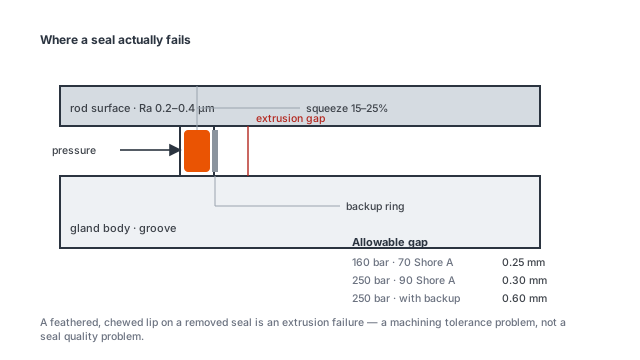
| Surface finish | Ra 0.2–0.4 µm | Seal life; too smooth holds no oil film |
Induction hardening gives a hard case and a tough core, which is the combination a rod needs. Through-hardening a rod makes it uniformly hard and uniformly brittle, and a brittle rod breaks rather than bends when something goes wrong — a bent rod is a nuisance, a broken rod is an accident.
Chrome thickness deserves a note. Thicker chrome lasts longer in abrasion but is more prone to cracking under bending, because a thick brittle layer on a ductile substrate fails when the substrate deflects. For high side-load applications, 20 to 25 µm on a hardened substrate outperforms 40 µm on a soft one.
Where standard chrome fails, and what to use instead
Three environments defeat a chrome-plated carbon steel rod, and each has a different fix.
Marine and offshore. Chloride pitting starts at any pinhole in the chrome and then the substrate corrodes underneath and lifts the plating. The fix is a stainless or duplex base material, with chrome or a ceramic coating on top for wear. Cost is several times higher, which is why it is specified only where a boot cannot protect the rod.
Water-glycol fluid (steel plants). Water-glycol corrodes carbon steel through any plating defect, and unlike salt it is already inside the system. Same fix: stainless substrate, or a water-compatible coating system.
Highly abrasive dust with high cycle count (mining, refuse). Abrasion wears the chrome through rather than corroding it. The fix is a harder surface: HVOF-applied ceramic or a nitrided layer, at two to four times the cost of hard chrome and five to ten times the life.
The rod end thread is the weakest section
This surprises people who have only ever seen a rod fail by bending: on a rod that is correctly sized for buckling, the first thing to break is the thread root at the rod end.
The reason is geometry. The thread root diameter is smaller than the rod diameter, so the stress there is higher; the thread is a stress concentrator with a sharp root radius; and the rod end is loaded in tension while the rod body is loaded in compression, so the fatigue mechanism is different.
Three mitigations are standard and cheap:
- Rolled threads rather than cut threads. Rolling work-hardens the surface and leaves a favourable residual stress pattern. It is the single highest-value process choice on a rod.
- A larger thread than the diameter suggests. Going up one size on the rod end thread costs almost nothing and removes the most common rod failure.
- A properly radiused transition between thread and shank. A sharp shoulder at that point is a fatigue crack waiting for cycles.
If a rod has broken at the rod end rather than bent in the middle, the fix is not a bigger rod — it is a bigger thread and a rolled one.
Failure modes and what each one means
| Symptom | Usual cause | Fix |
|---|---|---|
| Rod bent | Side load beyond design, or worn guides | Larger rod, renew guides, check alignment |
| Chrome peeling in patches | Corrosion under plating from pinholes | Stainless substrate or ceramic coating |
| Scoring along the rod | Contamination past the wiper | Double wiper, boot, check breather |
| Polished wear band at one point | Cylinder operating at a fixed partial stroke | Change duty cycle or install a wear ring |
| Thread stripped or broken at rod end | Undersized or cut thread | Rolled thread, one size larger |
| Pitting at the retracted wiper position | Salt or leachate sitting on a stationary rod | Boot, drain path, park retracted |
The fourth row is the one most often misdiagnosed. A rod that always works at the same partial stroke develops a polished band where the wiper sits, the wiper wears to match it, and the seal then leaks at every other position. The cylinder is not defective; it is being used at one point in its stroke, and the fix is operational.
Inspection criteria for a replacement rod
When measuring a rod for replacement, four checks catch almost everything:
- Straightness. Roll it on a flat surface, or indicate it between centres. More than about 0.5 mm per metre of total indicated runout means it is bent, and a bent rod will destroy the new seal.
- Diameter at several points. A rod worn below the nominal by more than a few hundredths of a millimetre will not seal with a standard seal.
- Surface condition at the retracted wiper line. Pitting here means the corrosion mechanism is active, and a new rod of the same material will pit in the same place.
- Thread condition. A stretched or damaged thread at the rod end is not repairable; the rod is scrap.
Chrome is a coating, not a dimension tolerance
Rods are ground before plating and finished after it, so the chrome thickness is part of the finished diameter — but the tolerance stack is often ignored when a rod is replaced. A rod plated to the top of its thickness range, in a gland machined to the bottom of its bore range, gives a clearance the seal was not designed for. Conversely, a rod polished to remove scoring can end up below the minimum diameter and leak from day one.
Specify finished diameter with tolerance rather than nominal diameter, and if a rod is being re-chromed, confirm that the base material is built back up before the new layer is applied rather than polishing the old one thinner.
What to specify
Rod diameter, material, surface hardness, chrome thickness, surface finish, rod end type and thread specification, and the environment — standard industrial, marine, water-glycol or high-abrasion. Those seven answers cover every rod decision in this article, and all but the last are one line each in an RFQ.