
Refuse equipment is the harshest normal-duty environment a hydraulic cylinder meets. Leachate is acidic, the load is abrasive and wet, and the cycle count is high enough that seal wear becomes a scheduled maintenance item rather than a failure.
Force is the easy part
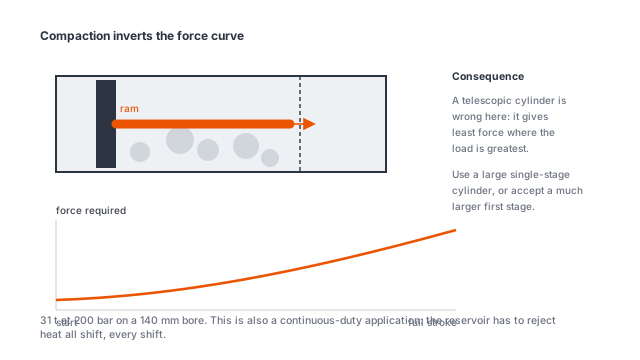
Packer and baler rams are sized for force and then chosen for durability. Municipal waste compacts to roughly 0.4 to 0.6 t/m³, and a body rated for 10 t of payload at that density needs a ram force in the 25 to 35 t range.
The arithmetic is straightforward. A 5.5 inch bore is 139.7 mm, giving an area of 0.0153 m². At 200 bar, force is 20 MPa × 0.0153 m² ≈ 307 kN, or 31.3 t. That single number explains why the rear loader range stops at a 5.5 inch bore: above it the ram force exceeds what the body structure can usefully take, and the extra tonnage goes into bending the packer plate rather than densifying the load.
| Function | Typical bore | Typical stroke |
|---|---|---|
| Packer / ejector ram | 4 to 5.5 in | 18.37 to 37 in |
| Side loader arm | 3 to 4 in | 8 to 40 in |
| Baler main ram | 5 to 7 in | application specific |
The rear loader range covers bores from 4 to 5.5 inches with rods from 2.5 to 4 inches and strokes from 18.37 to 37 inches across 6 models, covering the L and M slide, sweep and packer positions. The side loader range covers 3 and 4 inch bores with 8 and 40 inch strokes on the rapid rail grabber and 22 YD automizer arm.
Where the cylinder actually wears out
Two mechanisms dominate, and neither is the one most fleets plan for.
Rod contamination. Every stroke pulls the rod out of the gland and pushes it back. On a rear loader the rod sits directly above the hopper, so the return stroke drags leachate and grit across the wiper. Once the wiper lip wears, the grit reaches the rod seal and the seal cuts. A double wiper with a gap between the lips lets the first lip scrape and the second seal, and the gap gives the contamination somewhere to sit rather than be forced inward.
Rod bending from off-centre load. Packer rams are guided by the body structure, and when the guide wears the ram starts to cock. The cylinder then takes a side load that it was not designed for, and the gland bush wears oval. The fix is at the machine, not the cylinder: renew the guide pads when the ram starts to run off-centre, because a new cylinder in a worn guide fails the same way.
Cycle count and the maintenance interval
A rear loader on a municipal route runs 600 to 900 packer cycles a day. At 250 working days a year that is 150,000 to 225,000 cycles, against perhaps 3,000 for a tipper. Seal life is quoted in cycles for exactly this reason: a seal that lasts 500,000 cycles is a five-year part on a tipper and a two-year part on a refuse truck.
That also changes what “heavy duty” means. On a compactor cylinder, heavy duty is a thicker gland bush, a wider seal housing and a hardened rod, not a thicker barrel.
When the power unit is DC
Where a compactor is fitted to a trailer or a static skip frame without an engine, the DC hydraulic power unit covers 12 V or 24 V, 0.75 to 8 cc/rev pump displacement, 3 to 25 L/min flow and reservoirs from 3 to 16 L at 50 to 250 bar.
A compactor is a continuous-duty application, so the duty rating of the motor, not its peak power, is the limit. Running a 12 V unit at 25 L/min continuously will heat-soak the motor within 15 minutes unless the reservoir is at least three times the flow, and even then an oil cooler is usually necessary.
What to specify
Send the ram force required, the stroke, the cycles per day and the leachate exposure. The last one is what decides the rod finish and the wiper arrangement, and it is the difference between a two-year seal and a five-year one.