
Stage count is not a choice about strength. It is a trade: every stage you add buys retracted length and costs you force at the end of the stroke. Most telescopic cylinders are specified by copying the previous machine, which works until the body gets longer.
Where the number comes from
A single-stage cylinder needs a retracted length of roughly stroke plus 250 to 400 mm of end caps, gland and mounting. If you need 4,200 mm of stroke and you have 1,900 mm between the mounting and the underside of the body, no single-stage cylinder fits. You need stages.
The retracted length of a telescopic is approximately:
L ≈ (total stroke / number of stages) + end allowance
For 4,200 mm of stroke with a 500 mm allowance:
| Stages | Stage travel | Approx. retracted length |
|---|---|---|
| 1 | 4,200 | 4,700 |
| 2 | 2,100 | 2,600 |
| 3 | 1,400 | 1,900 |
| 4 | 1,050 | 1,550 |
| 5 | 840 | 1,340 |
This is the whole reason multistage cylinders exist: 4,200 mm of stroke out of a package 1,900 mm long. Three stages is the answer when the available envelope is 1,900 mm, and the envelope — not the load — is what sets the minimum.
What each stage costs you
Stages nest, so each one is smaller than the one before it. The step is set by the barrel wall thickness and the clearance needed for the bearing and seal pack, and in practice it is about 20 to 22 mm of bore diameter per stage.
Starting from a 158 mm first stage:
- 3 stages: 158 / 136 / 115 mm
- 4 stages: 158 / 136 / 115 / 93 mm
- 5 stages: 158 / 136 / 115 / 93 / 71 mm
Now convert to force at 160 bar. Piston area is π/4 × d², and force is area times 16 N/mm²:
| Stage bore | Area (cm²) | Force at 160 bar |
|---|---|---|
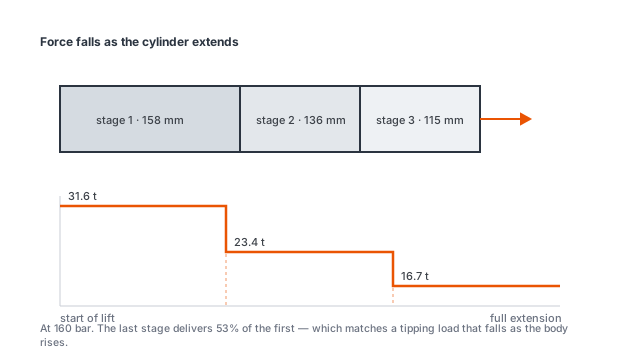
| 158 mm | 196 | 31.6 t |
| 136 mm | 145 | 23.4 t |
| 115 mm | 104 | 16.7 t |
| 93 mm | 68 | 10.9 t |
| 71 mm | 40 | 6.3 t |
A three-stage delivers 53 % of its starting force at full extension. A five-stage delivers 20 %. That is the trade, stated plainly: going from three stages to five saves 560 mm of retracted length and costs you more than half of your force at the top of the lift.
Why tipping tolerates it
On a tipper, this is not a problem, and the reason is worth understanding because it is the only reason multistage cylinders are acceptable at all.
The load moment falls as the body rises. At the start of lift, the payload centre of gravity is at its full horizontal distance from the hinge and the material is all still in the body. By the time the body is at 40 degrees, part of the load has slid towards the hinge and the rest is closer to it vertically. Both effects reduce the required force.
So the cylinder’s force curve — highest at the start, lowest at the finish — matches the load curve, which is also highest at the start. This is not a coincidence of design; it is why telescopic cylinders became standard on tipping bodies.
Note also that the largest stage extends first. This is forced by physics: the largest area generates the most force at a given pressure, so it moves first, and it keeps moving until it bottoms. The sequence is automatic and it is the right sequence.
When the trade is unacceptable
Any duty where force is needed at the end of the stroke is a bad telescopic application.
- Compaction and pressing. A refuse compactor needs maximum force when the ram is nearly fully extended and the material is densest. A multistage gives it minimum force there. Use a long single-stage cylinder with a deep installation envelope, or accept a much larger first stage.
- Lifting against a spring-like load. Anything where load increases with extension — a loaded boom, a tensioning application — inverts the match.
- Applications needing side load capacity at full extension. Five stages extended is a long, slender column. Overlap between stages is only 100 to 150 mm per joint, so the extended cylinder resists bending far less than a single-stage of the same stroke. If the load is not purely axial, count the stages against you.
For these, the honest answer is usually to find the installation length for a single-stage cylinder. Changing the machine geometry is cheaper than living with a cylinder that is working at 20 % of its rating when it matters.
The failure mode specific to many stages: sequence
A multistage cylinder extends in order because each stage is the path of least resistance. When one stage binds — from a scored tube, a damaged bearing, or contamination — the sequence breaks and a smaller stage extends early. This is called out-of-sequence extension, and it presents as a cylinder that judders, extends slowly, or stops short.
The probability rises with stage count simply because there are more bearing surfaces and more seals to damage. It is also worse on a cylinder that has been sitting: corrosion on an exposed stage, which is why the stages that stay out longest in dirty service are the ones to protect.
Two specification items reduce it: adequate overlap per joint, and a bearing material that does not pick up on a dry start. Neither appears on a standard datasheet.
A short decision procedure
- Fix the retracted length from the machine envelope, not from the old cylinder. This is a hard number.
- Compute the minimum stages from the table above.
- Compute the end-of-stroke force for that count, using the diameter step.
- Compare it against the required force at full extension, not at the start.
- If it is short, raise the first stage bore or the working pressure before adding stages — and check that the increased first stage still fits the mounting.
Adding stages to solve a force problem makes it worse. Adding stages is only ever the answer to a length problem.
The crossover with a single-stage cylinder
There is a point below which a multistage is the wrong answer even though it fits. The useful test is the ratio of required stroke to available retracted length:
- Stroke up to about 0.9 × available length: a single-stage cylinder fits. Take it.
- Stroke between 0.9 × and 2 × available length: two or three stages, and the end-of-stroke force is still respectable.
- Stroke beyond roughly 3 × available length: five stages or more, and the force at the top of the stroke is low enough that the duty has to be checked properly rather than assumed.
A single-stage cylinder of the same stroke costs more to install because it needs the envelope, but it has one barrel, one seal set, one bearing and no sequencing to go wrong. On a machine where the geometry can be changed — moving a pivot, shortening a body, relocating a cross member — that change is usually cheaper over the life of the machine than the additional stages.
Servicing a multistage
The other cost of stages is repair. On a single-stage cylinder the gland can usually be removed and the seal set replaced in place. On a multistage, reaching an inner stage seal means extracting the nested stages, which is a bench job with the cylinder removed from the machine.
This is not an argument against telescopic cylinders; it is an argument for buying the smallest number of stages that fits, and for specifying the seals and bearing surfaces for the duty rather than the price, because the labour to get to them is the expensive part of the repair.
Single-acting or double-acting
Almost all telescopic hoist cylinders are single-acting: oil extends them, gravity retracts them. It is cheaper, and retraction under a falling body is reliable.
Double-acting multistage cylinders exist and are expensive, because every stage needs a return path and the rod-side annulus of a nested design is awkward to seal. They are used where the cylinder must pull the body down — a low body that will not fall on its own, or a body that must be held down under load. If your body comes down on its own, do not pay for it.
The stage count decision does not change between the two. The cost of each additional stage does.