
A part number identifies a part in somebody’s catalogue. It does not describe the part. Two suppliers can both list a cylinder that “replaces” the same OEM number, and neither of them will fit the other’s machine, because each was reverse-engineered from a different sample, on a different day, with different assumptions about what mattered.
This article is not a cross-reference table. It is the method behind one, so that when a supplier sends you a drawing you can tell within ten minutes whether they measured the same cylinder you have.
Why a part number is not a specification
OEM part numbers are assigned for inventory control. They change when the supplier changes, when the paint colour changes, and when the assembly is superseded — and the supersession usually carries a dimension change with it. A single number can cover three different physical cylinders across a model run.
The catalogue entry behind that number typically carries: bore, stroke, rod diameter, and maybe a mounting code. It does not carry the four things that actually decide whether the cylinder works in your machine:
- The retracted pin-to-pin length, to the millimetre, under no load.
- The port thread and its orientation relative to the mounting.
- The pressure rating that the cylinder was designed to, not the one it survived in a burst test.
- The load case the OEM sized it for, which is often a specific body weight and payload that no longer matches what is on the truck.
A replacement built only on bore and stroke will bolt on and then either not reach full lift angle, bottom out before the body is down, or bend the first time the load is off-centre.
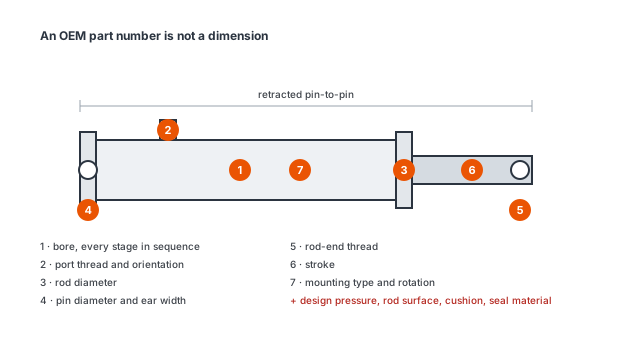
The seven hard dimensions
When we reverse-engineer a cylinder, these are the numbers that get recorded before anything is drawn. Every one of them is a fit-or-no-fit dimension; there is no range to negotiate.
Retracted length (pin to pin, or clevis face to clevis face). This sets the installed envelope. On a front-mount telescopic it is usually the binding constraint, because there is only so much room between the cab and the body hinge. A replacement 8 mm longer will not install; 8 mm shorter will lose stroke. Tolerance on this dimension should be stated as ±1 mm up to 2,000 mm, not as a percentage.
Extended length. Retracted length plus stroke. It sets the lift angle. Get it wrong and the body stops at 42° instead of 48°, and wet clay does not come out at 42°.
Bore of every stage, in sequence. On a multistage cylinder, “6 inch bore” is meaningless. A three-stage is 158 / 136 / 115 mm, in that order, and the order matters because the largest stage extends first. Swap stages two and three and you get a cylinder that starts weaker and finishes stronger, which is backwards for a tipping duty where the load falls as the body rises.
Rod diameter. This is the number most often guessed, because it is not visible on an assembled cylinder. It drives pull force, buckling capacity and — on a long-stroke single-stage — whether the cylinder survives at all.
Pin diameter and pin centre geometry. A 50 mm pin is not a 2 inch pin. SAE pins are imperial, most of the rest of the world is metric, and the difference is 1.6 mm of clearance that shows up as a knock on every reversal.
Port thread and port location. SAE straight thread O-ring boss, BSPP, NPTF, and metric fine are not interchangeable, and adapters cost you envelope and leak points. Port location is worse: if the port is on the wrong face of the cap, the hose does not reach.
Mounting code and its orientation. A cross tube is not a clevis is a trunnion, and the rotation of the mounting relative to the ports is specified in degrees on the drawing because there is no other way to say it.
The four soft dimensions that decide survival
These are the ones a cheap replacement quietly changes.
Design pressure versus test pressure. A cylinder tested at 1.5 × working pressure has demonstrated that it did not burst once. It has not demonstrated a fatigue life. If the cylinder sees pressure spikes from shock loading — and every tipping cylinder does — then the design pressure needs headroom above the relief setting, not equality with it.
Rod material and surface. Induction-hardened and hard-chrome-plated is the baseline for abrasive environments. A soft rod in a quarry will score within weeks, and scoring destroys the seal, not the rod.
Cushioning at the end of stroke. A cylinder that slams into its stop on every cycle transmits that impact into the body hinge and the chassis. Cushions are cheap to specify and impossible to retrofit.
Seal material. This is not on the datasheet most of the time, which is why it is the first thing to fail. Nitrile is fine for mineral oil under 100 °C. Polyurethane wears better but hydrolyses in hot, water-contaminated oil.
A worked example: three suppliers, one part number
Suppose the OEM number is for a three-stage front-mount cylinder on a 20-tonne rigid dump truck. The catalogue says “bore 158 mm, stroke 4,200 mm.”
Now three suppliers quote it:
- Supplier A matches 158 / 136 / 115 and 4,200 mm stroke, but quotes a retracted length of 1,940 mm where yours measures 1,918 mm. Not installable without moving the mount.
- Supplier B matches retracted length and stroke, but their stages are 158 / 140 / 120. Same closed length, more force at the top of the stroke, and 22 mm more material in the smallest stage. This one will work and will actually be stronger where it matters — but only if the body hinge and the mounting can take it.
- Supplier C matches everything and is 30 % cheaper. Their rod is C45 with no specified hardness and the ports are BSPP where yours are SAE-8. You will find both of those out on the first service.
None of this is visible from the part number. All of it is visible in ten minutes with a tape measure, a thread gauge and a magnet.
What to send when you ask for an interchange
You cannot get a correct replacement from a number alone. Send these and the quote comes back right the first time:
- Photographs of the cylinder installed, from both sides, showing the mounting and the hose routing.
- The retracted length, measured on the machine or measured off the cylinder on the floor with no load.
- The bore of the largest stage, measured at the outside of the barrel, minus twice the wall thickness if you can get it, or simply the outside diameter of each stage.
- The pin diameters, and the width across the mounting ears.
- A thread gauge reading on both ports, plus a photo of the port face.
- The relief valve setting on the circuit, and what the machine actually carries.
- What failed on the old one, and where.
That last one is the most useful and the most often omitted. If the old cylinder bent, a dimension-for-dimension replacement will bend again.
The honest limitation
If the OEM is still in business and the part is still in production, buy theirs. Interchange cylinders make economic sense when the machine is out of support, when the OEM lead time is measured in months, or when you are running a fleet with several body builders and want one spare that fits several trucks. They do not make sense as a way to save 20 % on a machine that is under warranty.
We build replacements by measurement, not by lookup, which is slower and means we will ask you for photographs before we quote. The alternative is the cylinder that bolts on and then teaches you which dimension nobody checked.