
A mining truck and a road tipper lift the same way. The cylinder on the mining truck fails differently, and it fails sooner, and neither of those facts is explained by tonnage. Three variables set the duty rating: how many times it cycles, what the pressure actually reaches, and how much grit gets past the wiper.
Cycle count: the one that surprises people
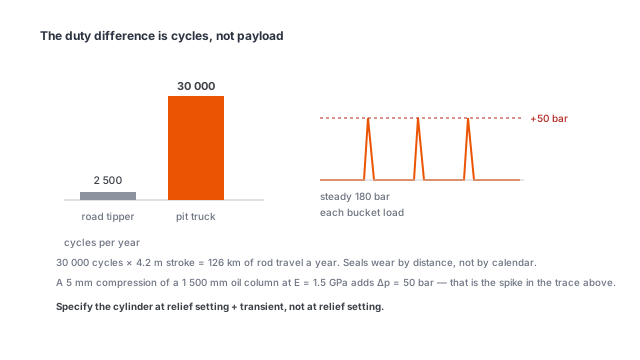
A road tipper on aggregate delivery might do ten lifts a day, 250 days a year. That is 2,500 cycles a year, and a cylinder designed for it will still be in service after a decade.
A rigid mining truck on a short haul does a lift every ten minutes for two shifts. At 100 cycles a day and 300 days a year, that is 30,000 cycles a year — twelve times the road machine. A cylinder that lasts ten years on the road lasts under a year in the pit at that rate.
Seals do not age, they wear. Wear is a function of sliding distance, and sliding distance is stroke times cycles. Over 30,000 cycles at 4,200 mm of stroke, the rod surface travels 126 km per year. That is the number to think about, not “two years.”
The specification consequence is material, not dimension. Everything that slides gets specified for distance: rod surface hardness and finish, bearing length, seal compound and the surface roughness of the counterface. A cylinder that is dimensionally identical but specified for road duty will weep within months.
Shock pressure: where the spikes come from
The load does not arrive gently. A wheel loader dropping 12 tonnes of blasted rock into a body from two metres up delivers an impact, and the cylinder is the spring that catches it — not because the cylinder is soft, but because the oil is.
Hydraulic oil is nearly incompressible, but not quite. Its bulk modulus is around 1.5 to 1.8 GPa, and that drops sharply if entrained air is present: one percent of free air by volume can halve the effective modulus. The pressure rise from a sudden compression is:
Δp = E × (ΔV / V)
Take a hoist cylinder with 1,500 mm of oil column. An impact that pushes the piston in by 5 mm compresses that column by 5 / 1,500 = 0.33 %. With E = 1.5 GPa:
Δp = 1.5 × 10⁹ × 0.0033 = 5 MPa, about 50 bar
That is on top of the steady load. A cylinder working at 180 bar during loading sees 230 bar for a few milliseconds, thousands of times a year. If the relief valve is set at 200 bar, it will crack on every single loading event, and the energy that would have gone into the structure goes into heat instead.
This is why mining hoist circuits get a higher design pressure than the steady load suggests, and why the cushioning matters: the cushion is what limits ΔV, and ΔV is what sets Δp.
Two things follow that are cheap to specify and expensive to retrofit:
- Design the cylinder against transient pressure, not relief setting. If the relief is at 200 bar and the duty generates 50 bar of spike, the working rating needs to be 250 bar, not 200.
- Specify the cushion for the impact, not for the end of stroke. A decelerating cushion at the top of travel does nothing for a loading shock at the bottom.
Dust: the failure most people misdiagnose
Rod seal failures in a pit are usually reported as seal failures. They are usually rod surface failures.
The mechanism is straightforward. Grit embeds in the wiper, the wiper stops wiping, and the embedded particle becomes a cutting tool that scores the rod on every retraction. A scored rod destroys the new seal within hours, which is why replacing the seal without addressing the rod or the wiper produces a repeat failure on a predictable schedule.
The defences, in order of effectiveness:
- A double-lip wiper, with a metal scraper ahead of it when the environment is coarse. A single lip passes what it cannot hold.
- Rod surface hardness. Hard chrome over an induction-hardened substrate survives; soft chrome over a soft core does not. In abrasive service, specify the substrate, not just the plating.
- Surface finish. Rod roughness of Ra 0.2 to 0.4 µm is the range where the seal can maintain its oil film. Rougher cuts the seal; smoother does not hold lubricant and the seal runs dry on startup.
- Boot or shield where geometry allows. Ugly, effective, and usually the first thing removed in service.
The structural margin
Mining bodies are loaded off-centre as a matter of routine. Rock does not distribute itself, and carry-back — wet material sticking to the floor of the body and releasing late — puts a load case into the cylinder that nobody drew.
The usual response is a higher safety factor on burst. Industrial construction often runs at a 4:1 burst-to-working ratio. For rigid truck hoist duty, 4:1 against steady pressure with transients counted in the working figure is the sensible minimum, and some operators ask for more.
The second response is bearing length. Side load from an off-centre body is resisted by the piston bearing and the gland bearing. Lengthening the bearing is a small dimensional change with a large effect on how long the cylinder survives misalignment. It is also invisible on the datasheet, which is why it is worth asking about explicitly.
Twin cylinders and the synchronisation problem
Above roughly 60 tonnes of payload, twin hoist cylinders are common. They halve the force per cylinder and they introduce a problem that single-cylinder designs do not have: the two cylinders must extend together, and nothing guarantees it.
Mechanical synchronisation is better than hydraulic for this duty. A cross-shaft or a rigid body structure forces alignment; a flow divider only approximately equalises flow, and the error accumulates over the stroke. A body lifted 30 mm out of level at the top of travel is a body with a torsional load in it, and torsional load is what cracks body hinges.
If twin cylinders are specified, ask where the synchronisation comes from. If the answer is “the flow divider,” ask what happens at the end of stroke.
Oil cleanliness is part of the duty rating
The same dust that scores rods also gets into the oil, through the breather, through the rod wiper and during every hose change in the field. Contaminated oil is abrasive oil, and it attacks the same surfaces from the inside.
A practical target for hoist circuits is ISO 4406 cleanliness of about 18/16/13, held by return-line filtration with a β₃ ratio of at least 200, plus a filtered breather on the tank. The filter element is a consumable; on a machine cycling 30,000 times a year it is a scheduled item, not a condition-based one.
Two things make this harder in the pit than on the road: hose changes happen outdoors, and the tank breathes more because the oil level swings with a large single-acting cylinder. Both argue for a higher-capacity breather and for quick couplings that are capped rather than open.
What to put in the enquiry
For a mining tipper, the standard cylinder enquiry — bore, stroke, pressure, mounting — is not enough. Add:
- Cycles per day and days per year, not “heavy duty.”
- Peak transient pressure, if you have measured it, or a description of how the body is loaded if you have not.
- The environment: dry dust, wet slurry, or both, and whether the machine is washed.
- Body geometry and payload distribution, including whether carry-back is expected.
- What failed on the previous cylinder and where, with a photograph of the rod.
That last item is the cheapest diagnostic available. A photograph of a scored rod, a rolled wiper or a cracked eye tells you more in ten seconds than a week of correspondence, and it usually identifies which of the three variables above was under-specified.