
Product line A · Tipping
Tipping & Dump
Four series cover tipping duty: FC and FE are front-end cylinders, FEE is the lighter front-end range, Underbody sits beneath the floor for dump trailers, and HTT is a scissor hoist. Between them they list 84 models, from 5 t tipping capacity on the smallest underbody unit to 64 t on the largest front-end cylinder.
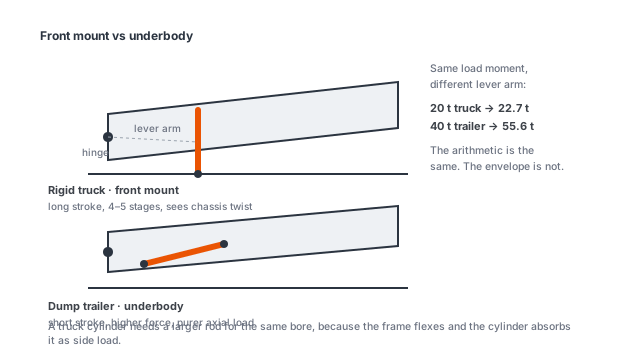
The choice between front-end and underbody is decided by the vehicle, not by capacity. A front-end cylinder needs clear space between the cab and the body front board and pushes the body up from the front; an underbody cylinder works within the chassis rails and is the only option where the body has no room at the front.
Within the front-end group, FC and FE are not interchangeable even where the capacity matches: their bore progressions differ, so the frame mounts differ. Matching capacity alone is the most common way a cylinder arrives and does not fit.
5 product lines in this section
3TG / 4TG / 5TG / 6TG series
Underbody Telescopic Hydraulic Cylinder
Three- to six-stage underbody cylinder in 90, 105 and 130 mm effective diameter series, with 806–1,947 mm power stroke and 5–25 t tipping capacity for dump trailers.
- series
- E90 / E105 / E130 (effective diameter)
- stages
- 3 to 6
- power stroke
- 806 – 1,947 mm
- max working pressure
- 180 – 220 bar
FC series, 27 models
FC Telescopic Front-End Cylinder
Front-end telescopic cylinder for dump trucks, 27 models from 28.3 t to 64 t tipping capacity at 16–20 MPa, with closed lengths from 1,195 mm to 1,945 mm.
- tipping capacity
- 28.3 – 64 t
- working pressure
- 16 – 20 MPa
- models listed
- 27
- stages
- 4 to 6
FE series, 13 models
FE Telescopic Front-End Cylinder
Front-end telescopic cylinder for straight-headboard dump trucks, 13 models at 28.3, 49 or 64 t tipping capacity and 16 MPa working pressure, with closed lengths from 1,240 mm to 1,732 mm.
- tipping capacity
- 28.3 / 49 / 64 t
- working pressure
- 16 MPa (160 bar)
- models listed
- 13
- stages
- 3 to 6
FEE series, 9 models
FEE Telescopic Front-End Cylinder
FEE front-end telescopic cylinder, 9 models with lifting weight from 15.5 t to 51.3 t at 16 MPa, 3 to 5 stages, and closed lengths from 1,304 mm to 1,819 mm.
- lifting weight
- 15.5 – 51.3 t
- working pressure
- 16 MPa (160 bar)
- models listed
- 9
- stages
- 3 to 5
HC-310 to HC-630, 7 models
HTT Series Scissor Hoist
Double-acting scissor hoist for dump bodies, 7 models with 3 to 6 inch bore and a capacity range from 2.8 t to 15.4 t, for body lengths from 30.8 to 69 inches.
- capacity range
- 2.8 – 15.4 t
- bore
- 3 – 6 in
- stroke
- 10 – 30 in
- body length
- 30.8 – 69 in
How to choose within this section
- Start from the mounting envelope
- Closed length decides fit before capacity does. FC runs 1,195–1,945 mm closed, FE 1,240–1,732 mm, FEE 1,304–1,819 mm, Underbody 806–1,947 mm.
- Then check capacity against the load
- Front-end covers 28.3–64 t, FEE 15.5–51.3 t, underbody 5–25 t and the HTT scissor hoist 2.8–15.4 t. The ranges overlap, which is why the envelope comes first.
- Count the stages against the stroke you need
- More stages give a longer stroke from a shorter retracted length — the underbody series reaches 1,947 mm in 6 stages but only 806 mm in 4.
- Confirm the frame mount on the drawing
- Every series has its own mounting dimensions. The table selects the model; the drawing is what we build to.
Not sure which series fits your equipment?
Send the mounting envelope, the load and the stroke you need. We will tell you which series it lands in and why, before you commit to a design.