
Product line A · Hooklift & Crane
Hooklift & Crane
Two related product lines: complete hooklift systems for roll-off containers, and the cylinders that drive truck-mounted cranes. Together they list 12 models, from a 5.5 t hooklift to a 3,500 mm stroke crane cylinder.
A hooklift is sold as a system — base frame, lift cylinder, hook arm, secondary lifting arm and directional control valve — so the specification that matters most is not the cylinder but the subframe: the secondary beam width has to match the chassis rails.
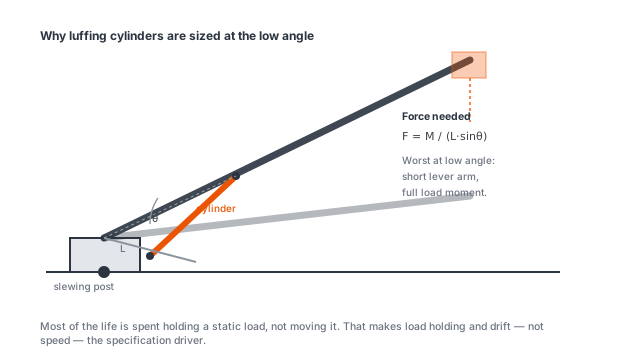
Crane cylinders are the opposite case. They are selected on bore/rod ratio and stroke, because the ratio sets the extend and retract force difference, which decides whether the cylinder can hold a load on the retract side.
2 product lines in this section
H&H series, 5 models
Hooklift System
Hydraulic hooklift for roll-off containers, 5 models with 5.5 to 18 t lift capacity, jib height 1,500–1,600 mm and overall length from 3,800 mm to 5,880 mm.
- lift capacity
- 5.5 / 6 / 18 t
- self weight
- 1,000 – 2,600 kg
- jib height
- 1,500 – 1,600 mm
- overall length
- 3,800 – 5,880 mm
HSG series, 7 models
HSG Crane Cylinder
Hydraulic cylinder for truck-mounted cranes, 7 models at 20 MPa with bore and rod combinations from 50/28 mm to 200/140 mm and strokes from 430 mm to 3,500 mm.
- working pressure
- 20 MPa (200 bar)
- bore / rod
- 50/28 – 200/140 mm
- stroke
- 430 – 3,500 mm
- models listed
- 7
How to choose within this section
- Hooklift: match the subframe before the capacity
- Secondary beam width is 750 or 850 mm. Get that wrong and the unit will not sit on the chassis regardless of lift capacity.
- Hooklift: capacity steps are large
- 5.5 t, 6 t and 18 t — there is no intermediate. The 18 t unit weighs 2,600 kg, so it is a chassis question as much as a hydraulic one.
- Crane: bore/rod ratio sets retract force
- HSG runs from 50/28 to 200/140 mm at 20 MPa; the annulus area is what holds the load on the way down.
- Crane: stroke is limited by buckling
- The 3,500 mm stroke model uses a 70 mm rod. Longer than that and the rod diameter has to step up again.
Not sure which series fits your equipment?
Send the mounting envelope, the load and the stroke you need. We will tell you which series it lands in and why, before you commit to a design.