
Product line A · Container handling
Container Handling
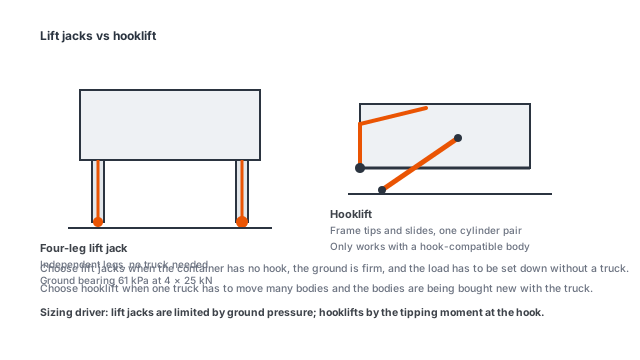
One product line sits outside the vehicle hydraulics: a four-leg lift jack set for containers. Each leg is rated 8 t, so a set of four carries 32 t, and the legs lift at the container corners — no crane or reach stacker involved.
The two models differ in supply and motor rather than in lifting performance: 24 V with a 2 kW motor at 800 kg per leg, or 380 V with 2.2 kW at 760 kg. Lift height and speed are identical at 1,700 mm and 21 mm/s.
Because each leg sits on castors, the set can be repositioned on flat concrete or asphalt without a forklift. That is what makes it usable in a yard that has no fixed handling equipment.
1 product line in this section
HCCL8.0XW-4 / HCCL8.0X-4
Hydraulic Container Lift Jack
A four-leg hydraulic lifting set for containers, rated 8 t per leg with a 1,700 mm lift height. The legs lift at the container corners, so no crane or reach stacker is needed.
- lifting capacity
- 8 t per leg (32 t per set of four)
- max lift height
- 1,700 mm
- lifting speed
- 21 mm/s
- motor power
- 2 kW (24 V) / 2.2 kW (380 V)
How to choose within this section
- Choose supply by what the yard already has
- 24 V runs from a battery or a small power pack; 380 V needs a three-phase supply where the container is being handled.
- Check the surface
- Each leg weighs 760–800 kg and carries 8 t. Castors roll on flat concrete or asphalt, not on gravel or unimproved ground.
- Plan for four
- The set is specified as four legs at the container corners. Loading one corner at a time from a single leg is outside the rated capacity.
Not sure which series fits your equipment?
Send the mounting envelope, the load and the stroke you need. We will tell you which series it lands in and why, before you commit to a design.